 01903 372752
Why Modern Homes in West Sussex Are Perfect for a Heat Pump
One of the things we say to every customer who gets in touch with Revolution Heating is this: a heat pump will work in almost any home. It really does come down to good system design…
Share This Post!
One of the things we say to every customer who gets in touch with Revolution Heating is this: a heat pump will work in almost any home. It really does come down to good system design and setting the right expectations about what work is involved to get there. An older Victorian terrace or a 1970s semi can absolutely run a heat pump well – it just takes a different approach, and sometimes a bit more groundwork, than a modern property.
That said, if you live in a home built after 2002 in West Sussex – and your gas boiler is getting on a bit – you’re sitting in one of the easiest, most cost-effective categories of heat pump installation there is. The building fabric is already doing most of the work for you. Plus if you’re in an area like Angmering, Rustington, Horsham, Lancing, Southwater, or Burgess Hill, the chances are your home ticks every box.
In this article I want to explain why 2002 is the key date, which areas of West Sussex have the highest concentration of these homes, and share a recent job we completed in Highwood, Horsham, to show exactly what the process looks like in practice. If you’re in an older property and wondering whether a heat pump could work for you – it very likely can, and we’ll be writing a dedicated article on exactly that soon.
Why 2002 Is the Key Date - And What It Means for Your Home
Before getting into the detail, it’s worth being clear about something: the age of your home affects how straightforward a heat pump installation is, not whether it’s possible. We design and install heat pump systems across all property types – from period homes to 1960s bungalows to brand new builds – and with the right approach, they work well in all of them. The difference with modern homes is really one of cost and complexity. Less work tends to be needed upfront, which means lower installation costs and a faster route to a performing system.
So why does 2002 specifically matter? It’s not arbitrary.
In 2002, the UK Government introduced a major revision to Part L of the Building Regulations – the section that governs the conservation of fuel and energy in new buildings. Coming into effect for new homes from the start of 2003, Part L 2002 set significantly higher
insulation standards and thermal performance requirements for all new dwellings. This was a genuine step change. Homes built to meet these new standards had to demonstrate much lower levels of heat loss through their walls, roofs, floors, and windows than anything that came before.
In practical terms, this means that a home built in 2003, 2005, 2008, or 2012 is likely to have:
- Fully filled cavity wall insulation meeting tighter U-value requirements
- Double glazing with better thermal performance than older units
- Loft insulation to higher specifications
- Better airtightness throughout the building fabric
- Improved floor insulation, particularly in homes with underfloor heating
All of these things matter for heat pump performance. A heat pump doesn’t produce the same high temperatures as a gas boiler – it works at lower, steadier flow temperatures, typically around 35–50°C. That means the better insulated your home, the more efficiently it operates and the lower your running costs. In a less well-insulated property, we simply design around what’s there – sometimes recommending targeted improvements, sometimes finding the existing setup is better than expected. But in a post-2002 home, the fabric is almost always already doing what it needs to.
What About Homes Built Between 2002 and Today?
Part L has been revised several times since 2002, with each revision tightening the standards further. Homes built after 2006, 2010, and particularly after 2013 are progressively better insulated still. By the time we get to homes built in the last decade, we’re often looking at properties with underfloor heating already on the ground floor, high-performance glazing, and very low heat loss figures – which makes for a beautifully straightforward heat pump installation, as the Horsham case study below shows.
If your home was built anywhere between 2002 and the present day, it’s well worth getting a proper assessment. The likelihood is that a heat pump will be an excellent fit.
Areas in West Sussex With High Concentrations of Post- 2002 Homes
West Sussex has seen significant housing development since the early 2000s, and several areas have particularly high concentrations of homes in that ideal bracket. Here’s where we’re seeing the most interest – and doing the most work.
Angmering
Angmering has been one of the most actively developed villages in West Sussex over the past two decades. Developers including Bellway, Cala Homes, and Persimmon have delivered large estates here, with developments like Langmead Place, Harvest Rise, Ecclesden Park, and Fairway Gardens adding hundreds of well-built modern homes to the village. Many are detached and semi-detached family homes – exactly the kind of property where a heat pump performs at its best.
Rustington
Just along the coast, Rustington has a significant proportion of post-2002 housing stock – particularly on the northern and eastern fringes of the village. A large number of homes here date from the mid-2000s through to the early 2010s, and many of the original gas boilers in these properties are now reaching the end of their serviceable life. That’s a common trigger for heat pump enquiries, and rightly so.
Horsham
Horsham is probably the single biggest growth area in West Sussex for newer housing. The town and its surrounding villages – including Southwater, Broadbridge Heath, and Roffey – have seen massive development since the early 2000s. The Highwood Village development by Berkeley Homes is one of the most prominent examples, and it’s where our most recent case study comes from. We do a lot of work in and around Horsham, and it’s an area where the housing stock really does lend itself to straightforward, cost-effective heat pump installations.
Lancing and Shoreham-by-Sea
The coastal strip between Worthing and Brighton has a surprising number of post-2002 estate homes. Lancing in particular has several developments from the mid-2000s and early 2010s, and we’re seeing real interest from homeowners there who want to move away from gas.
Southwater and Broadbridge Heath
These villages just south of Horsham grew enormously from the early 2000s onwards, with large Bovis and Persimmon estates built across what were previously fields. The homes are well-
insulated, typically have condensing boilers installed between 2005 and 2015, and many of those boilers are now approaching or past their best.
Burgess Hill and Haywards Heath
Mid Sussex has seen consistent development throughout the 2000s and 2010s. Burgess Hill has a number of developments on its eastern and northern edges, and Haywards Heath’s surrounding villages have attracted a lot of family homes in the right age range – often good-sized properties with gardens and the space needed for an external heat pump unit.
Chichester, Westergate, and the Coastal Plain
The area west of Worthing – particularly around Westergate, Barnham, Tangmere, and on the outskirts of Chichester itself – has seen significant residential growth since 2002. These are often larger family homes, built to modern standards, and ideal candidates for heat pump installation.
The Problem With Waiting: Ageing Boilers in Modern Homes
Here’s the situation a lot of West Sussex homeowners find themselves in right now.
They bought their home in 2004, 2007, or 2011. It came with a brand new Worcester Bosch or Vaillant gas boiler. That boiler has done its job quietly for over a decade, but it’s now starting to cause trouble. Annual services are flagging up wear. Parts are getting harder to source. And somewhere in the back of their mind, they know a breakdown is coming.
The instinct is to replace it with another gas boiler. And yes, that’s still an option. But if your home was built after 2002 and is already well-suited to a heat pump, why spend £3,000 upwards
locking yourself into another 15 years of rising gas bills? The government’s Boiler Upgrade Scheme (BUS) grant of £7,500 changes the calculation significantly. In many cases, after the
grant, the cost of a properly designed heat pump installation is comparable to a quality boiler replacement. And with solar PV becoming increasingly common on modern homes, the case for a heat pump becomes even more compelling.
A Recent Job: Heat Pump Installation in Highwood, Horsham
The Property and the Problem
The customer came to us from one of Horsham’s most desirable modern developments – a five- bedroom detached home in Highwood, built to a high specification and home to a family of four (and one very important kitten). The house was exactly the kind of property that suits a heat pump perfectly, but that wasn’t actually why they called us.
The driver here wasn’t a broken boiler. It was frustration. Like a lot of homeowners, they’d had enough of watching energy prices climb year after year, driven by events entirely outside their
control. They’d already taken one significant step toward energy independence by having solar PV panels and batteries installed – and now they wanted to complete the picture. All that clean electricity they were generating on their roof was still being used to power a home heated by gas. That felt like a waste, and it was. A heat pump would allow them to use their own solar energy to heat their home, with the battery providing a buffer to maximise self-consumption. It’s a combination that makes very strong financial and environmental sense.
What We Found on Survey
Being a recently built modern home, the insulation levels were excellent – exactly what you’d expect from a property built to current standards. The house also had the ideal emitter setup for a heat pump: underfloor heating throughout the entire ground floor, with radiators and towel rails upstairs.
We carried out a full heat loss survey of the property, which came back with a design heat loss of just 4.5kW at -2°C – impressively low for a five-bedroom house, and a testament to the quality of the building fabric. Even better, our calculations showed that a flow temperature of just 35°C would comfortably satisfy that heat loss at design conditions. To put that in context, a well- designed heat pump running at 35°C is operating at peak efficiency – meaning lower running costs and a higher SCOP (420% performance guarantee in this case). This was about as good a starting point as you can get.
The Installation
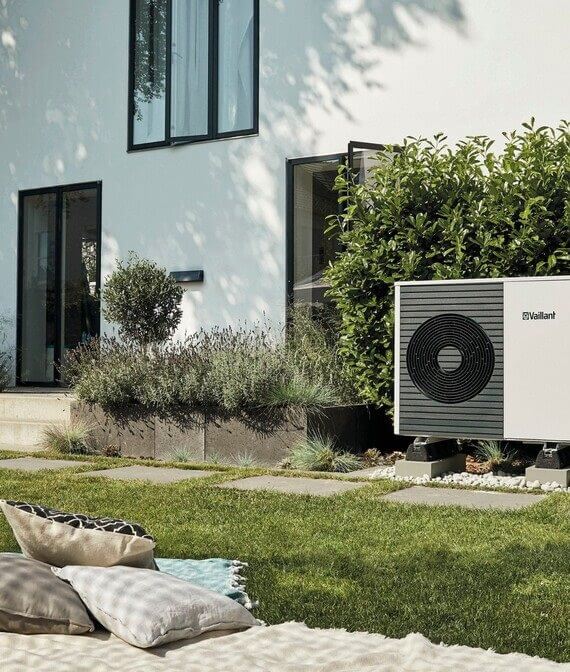
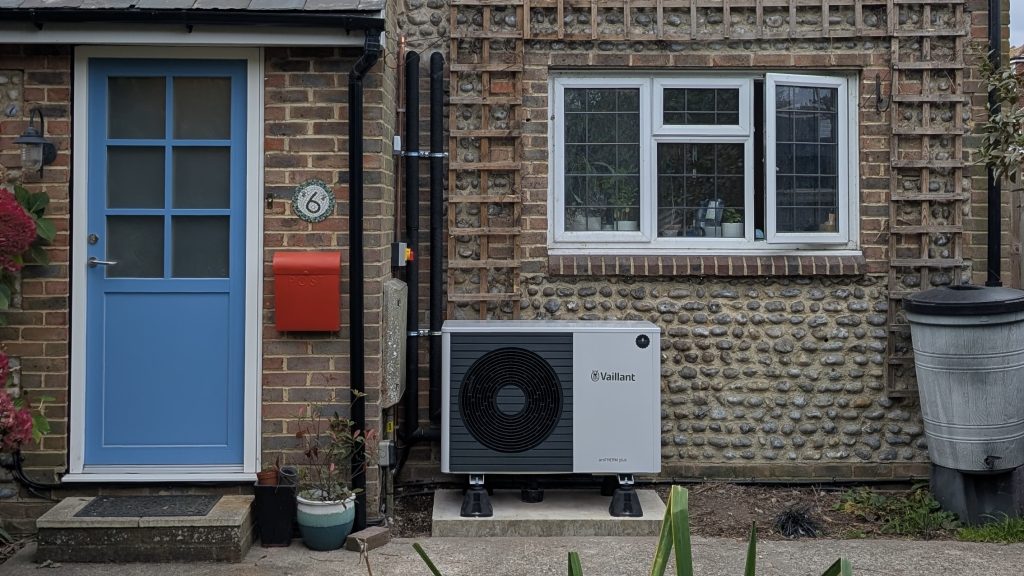
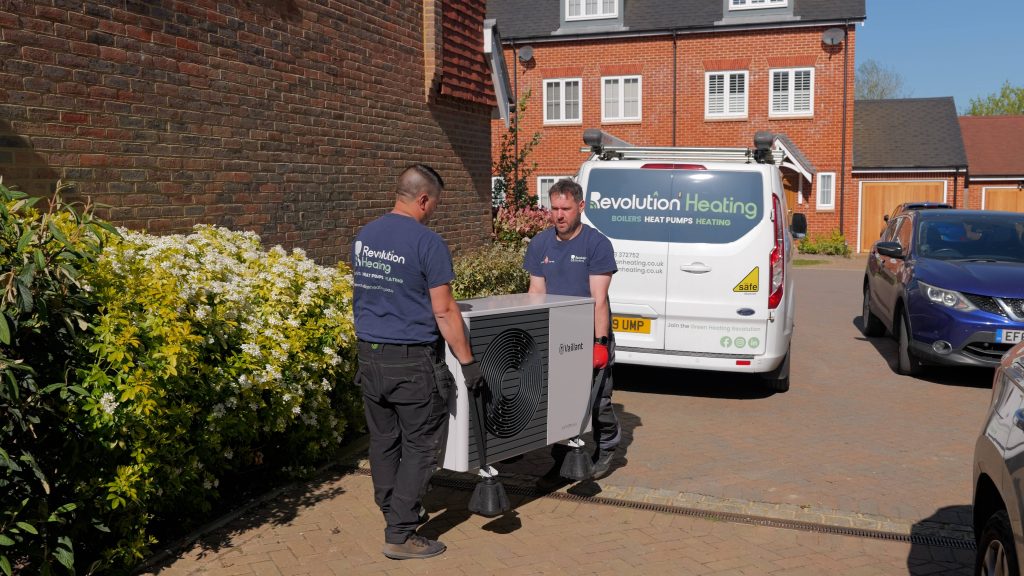
We installed a Vaillant Arotherm Plus 5kW heat pump to the side of the property with some long primary pipe runs and external trunking.. The homeowner had done a great job of preparing a solid, level base for the unit – one of those small things that makes a real difference to the quality and neatness of the finished installation.
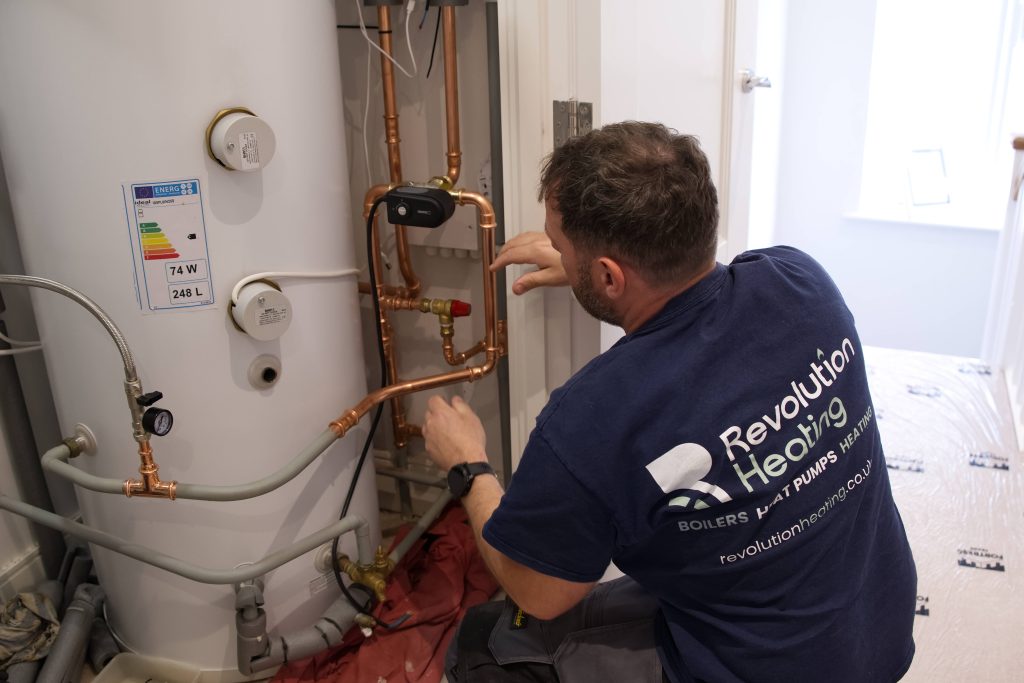
Pipework from the heat pump was run in black trunking up and into the loft space, keeping everything clean and unobtrusive from the outside. Inside, the job was remarkably straightforward: the existing hot water cylinder was already in place and suitable for use with the heat pump, so we kept it. The old boiler was removed, and the heat pump effectively took its place in the system – just located externally rather than in the utility room (cupboard space regained).
A full system flush was carried out as part of the commissioning process, as it is on every job we do. The heat pump was also fitted with an energy monitoring device, so the homeowner cantrack exactly how much energy the system is using, how efficiently it’s running, and how much of their own solar generation is being used to heat their home. You can view the live
performance data here.
The Result
The family now have full visibility and control over the energy used to heat their home. The heat pump draws on the solar PV and battery system first, meaning a significant proportion of their heating energy comes directly from the panels on their roof – produced for free and with zero carbon emissions. At the point of use, the system produces no CO2 at all.
The house maintains a comfortable, even temperature throughout, with the underfloor heating on the ground floor doing exactly what it was always designed to do – just now powered by a heat pump running at the low flow temperatures it was designed for, rather than a gas boiler pushing temperatures far higher than necessary.
For a family that wanted energy independence, this is about as close as you can get with current technology.
Total cost after the £7,500 Boiler Upgrade Scheme grant: £4,350 (including the energy monitor add-on, long primary pipe runs and external trunking add-on)
How We Do It: The Heat Geek ZeroDisrupt Approach
We’re a Heat Geek-trained installer, and one of the things that sets us apart is our use of the ZeroDisrupt installation system – and it’s particularly well-suited to the kind of post-2002 West
Sussex homes we’ve been talking about throughout this article.
For years, heat pumps had a reputation for being expensive, disruptive, and overcomplicated. Quotes of £12,000–£15,000 were common even after the BUS grant, and installations often meant weeks of upheaval. ZeroDisrupt changes that. It uses an AI-driven system design tool, trained on data from thousands of real UK homes and live monitored heat pump installations, to work out precisely what your home needs – and what it doesn’t.
The result is a streamlined, properly engineered installation that:
- Removes unnecessary upgrades - no ripping out radiators that don't need to be changed
- Reduces time on site - most installations complete in 2–3 days
- Brings costs down significantly - often comparable to a boiler replacement after the £7,500 BUS grant
- Is designed for real-world performance - every system is monitored against live data
The Highwood job is a good example of this in practice. The home’s excellent insulation and low heat loss meant the system could be sized precisely, without over-engineering. The existing cylinder was retained, the radiators upstairs were already adequate, and the underfloor heating downstairs was perfectly matched to the heat pump’s operating temperatures. The result was a clean, efficient installation completed without disruption to the family – and a system that’s now performing exactly as designed.
How Much Does It Cost?
At Revolution Heating, our Heat Geek ZeroDisrupt heat pump installations start from around £2,800 for qualifying properties – after the government’s £7,500 Boiler Upgrade Scheme grant has been applied. The Horsham installation above came in at £4,350 after the grant, which included the energy monitoring add-on.
The final figure depends on:
- The size and heat loss of your home
- Whether your existing radiators are suitable or need changes
- Whether a new hot water cylinder is required
- The heat pump model specified for your property
For most post-2002 homes in West Sussex in good condition, costs sit toward the lower end of the range – particularly where insulation is solid, radiators are adequate, and there’s a suitable outdoor space for the unit.
We cover West Sussex and surrounding areas, including Angmering, Rustington, Worthing, Horsham, Southwater, Lancing, Shoreham, Burgess Hill, Haywards Heath, Chichester, Bognor
Regis, and all the towns and villages in between.
Get a Price for Your Home
Whether your home was built after 2002 or well before it, if you’re thinking about a heat pump we’d love to hear from you. A proper heat loss assessment and honest conversation about what’s involved is always our starting point – whatever the property.
For post-2002 homes in West Sussex in particular, the process is often simpler and more affordable than people expect.